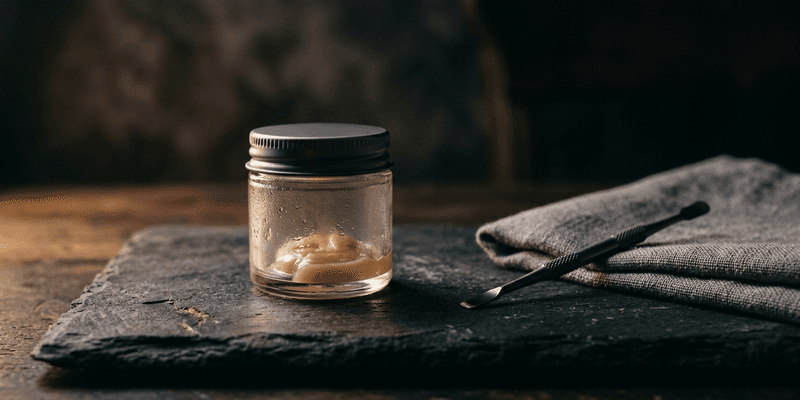
What the Jar Test Tells You

The jar test (sometimes called the grease test or melt test) is a quick field assessment for bubble hash quality. You press a small amount of hash against the inside of a clean glass jar and observe how it melts. High-quality full melt hash will grease up on the glass — spreading into a translucent, oil-like film with little to no visible residue. Lower-grade hash leaves opaque smears, dark specs, or plant material that won't melt into the glass at all.

The test gives you a rough quality grade before you commit time or material to further processing. Hash makers use it to decide which micron pulls are worth pressing into rosin, which are suitable for temple balls, and which should be set aside as cooking grade. It takes about 30 seconds and requires no equipment beyond a glass jar and a hash sample.

What You Need

  • A clean glass jar: A standard mason jar works. The glass must be clean and dry — any residue, moisture, or fingerprints on the surface will interfere with reading the results. Wipe the inside with isopropyl alcohol and let it dry completely before testing.
  • A small hash sample: A piece roughly the size of a grain of rice is enough. You want a consistent amount each time so you can compare results across batches and micron pulls.
  • Warmth: Your thumb provides enough heat. Some people use the warmth of their palm or hold the jar near a heat source briefly, but body heat pressed against the glass through the sample is the standard method. You are not trying to dab the hash — just warm it enough to observe melt behavior.

How to Do the Jar Test Step by Step

  1. Take a consistent sample. Pinch off a small, uniform piece of dried hash. If you are comparing multiple micron pulls from the same wash, use the same amount from each. Consistency across variables — sample size, hash moisture content, glass temperature — makes comparison meaningful.
  2. Press it against the glass. Place the sample on the inside wall of the jar. Press your thumb firmly against the outside of the glass, directly behind the sample, so your body heat transfers through. Hold pressure for 10 to 20 seconds.
  3. Smear and observe. While pressing, drag the sample slowly across the glass. You are looking at how the hash behaves as it warms and spreads — does it melt cleanly into the glass, or does it resist and leave chunks behind?
  4. Read the smear. Hold the jar up to a light source. The quality of the smear tells you the grade. See the next section for how to interpret what you see.
  5. Clean between samples. If testing multiple pulls, wipe the glass with isopropyl alcohol and dry it completely before the next test. Cross-contamination between samples defeats the purpose.

The late Frenchy Cannoli popularized this technique in his workshops and videos. His demonstrations showed how dramatically different micron pulls from the same wash can behave on glass — from full grease to zero melt — making the jar test one of the most accessible quality checks in hash making.

Reading the Results

What you see on the glass corresponds roughly to the star grading system used across the solventless industry. Here is what each result means:

  • Clear, translucent grease (5-6 star): The hash melts completely into the glass, leaving a light golden or amber oil film with no visible plant matter. When held to light, the smear is see-through. This is full melt — the highest grade. It can be dabbed as-is or pressed into premium six-star rosin.
  • Mostly translucent with slight haze (4-5 star): The smear is largely clear but has a faint cloudiness or a few tiny dark specs. Very good quality. This hash presses well into rosin and is close to full melt, but has minor contamination that prevents a completely clean dab.
  • Semi-opaque, visible residue (3-4 star): The smear spreads but remains cloudy or milky. You can see plant particulate in the film. This is half melt — a solid mid-grade hash that works well for pressing into rosin but is not suitable for dabbing on its own.
  • Opaque, dark, does not grease (1-2 star): The hash resists melting, crumbles or smears without going translucent, and leaves dark residue or visible green/brown plant material on the glass. This is cooking grade. It contains too much contamination for pressing or dabbing but still has value in edibles or as a base for infusions.

Color alone is not the indicator — transparency is. Some cultivars produce hash with a naturally darker color that still greases up clean. Others produce pale hash that leaves residue. The jar test measures melt behavior, not appearance.

How the Jar Test Relates to Star Grades

The 1-to-6 star grading system is built on melt quality, and the jar test is one of the primary ways hash makers assign those grades in practice. When a producer labels a product as 5-star or 6-star, they are claiming it greases up clean on glass with minimal to no residue.

Most hash makers test every micron pull individually. A single wash can produce 6-star material in the 73-90 micron range and 2-star material in the 160+ micron range. The jar test is what separates them. Temple ball makers also rely on this test — if the hash does not grease clean, it will not produce the smooth, uniform melt that defines a quality temple ball.

Some cultivars are known to produce exceptional hash regardless of technique. Genetics bred specifically for trichome production — large, stalked heads that separate cleanly — will consistently test well on glass. As one community member put it about a well-known hash cultivar: "Jar test if you must — but if it's a proven hash plant, it's bred to dump." The jar test confirms what genetics promise.

Limitations of the Jar Test

The jar test is a qualitative field check, not a lab result. It tells you about melt quality and plant contamination, but it does not measure potency, terpene content, or the presence of contaminants like pesticides or microbials. A sample that greases up perfectly could still test low in cannabinoid content or fail a compliance panel.

Interpreting results takes experience. Beginners often mistake partial melt for full melt, or misjudge translucency under poor lighting. Running the test in consistent conditions — same light source, same sample size, same glass temperature — reduces variability. But two people can look at the same smear and disagree on the grade.

Moisture content also affects results. Hash that has not been properly dried may appear to grease when it is actually just smearing wet trichomes across the glass. The jar test works best on hash that has been freeze-dried or air-dried to a stable moisture level before testing.

For definitive quality assessment, lab testing is the only answer. The jar test is a screening tool — useful for sorting micron pulls, making processing decisions, and getting a fast read on a batch. It is not a substitute for comprehensive quality evaluation.

Jar Test FAQ

Can I use any glass surface for the jar test?

Any clean, smooth glass works — a mason jar, a drinking glass, or a glass plate. The key requirements are that the glass is completely clean (no oils, residue, or fingerprints) and smooth enough to see through the smear. Most people use a jar because the curved surface makes it easy to press from the outside with a thumb.

Does the jar test work on rosin or only on hash?

The jar test is designed for unpressed bubble hash. It helps you decide what to do with the hash — dab it, press it, or set it aside. Rosin has already been pressed, so its quality is better assessed through other methods like color, consistency, and melt behavior on a nail. For evaluating finished rosin, see how to tell if rosin is good.

How much hash do I need for a jar test?

A piece about the size of a grain of rice. Using a consistent amount each time is more important than the exact quantity. If you are comparing micron pulls, weigh out the same amount for each sample so the results are directly comparable.

What if my hash greases but has a dark color?

Color varies by cultivar and does not automatically indicate quality. Some strains produce naturally darker trichome heads that still grease up completely translucent. The indicator is transparency, not color. If the smear is see-through when held to light, the hash is high quality regardless of its tone.

Is the jar test the same as a dab test?

No. A dab test involves vaporizing hash on a heated surface (like a quartz banger) and observing how it melts and what residue remains. The jar test uses only body heat and glass — no vaporization. Both assess melt quality, but the jar test is quicker, does not require a rig, and uses a smaller sample. The dab test gives you additional information about flavor and vapor quality.

When should I do the jar test during production?

After drying and before any further processing. Test each micron pull separately once the hash is dry enough to handle. This is the decision point: the results tell you which pulls to keep as dabbing-grade hash, which to press into rosin, and which to reserve for edibles. Testing before the hash is fully dried can give misleading results because moisture interferes with melt behavior.