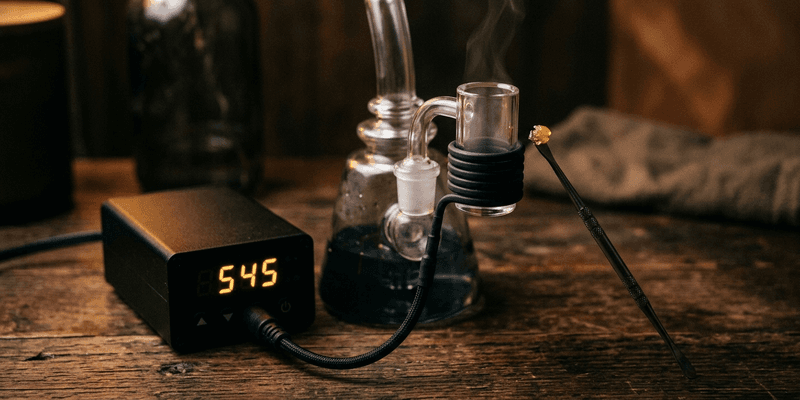
Best Enail Temperature at a Glance
Set your enail controller between 500 and 550°F for quartz bangers using a flat coil. The controller readout shows the heat in the coil, but the surface where you drop the dab is usually 50 to 100°F cooler. This gap changes based on your hardware and room temperature. For live rosin or hash rosin, start at 500°F and move up until the vapor is thick enough without tasting harsh. Flower rosin usually needs a bit more heat, so start near 530°F. Enails give you a consistency that torches can't match. Once you find the right number, it stays there.
Why Controller Temp Isn't Surface Temp
Most "burnt dab" complaints come from a misunderstanding of how enails work. The PID controller measures heat from a sensor in the coil, not from the banger surface. Heat has to travel through the metal or quartz to reach your rosin. That transfer is never perfect.
The gap between the readout and the dabbing surface depends on a few things. Titanium conducts heat fast, so the offset is small (30 to 60°F). Quartz is slower, creating a larger gap of 50 to 100°F. A snug coil with full contact transfers heat better than a loose one. Even a cold room or a draft can pull heat away from the nail surface and widen that gap.
When someone says they dab at 520°F on an enail, that number is meaningless without knowing the material and coil type. Use an IR thermometer or a contact tool like a Terpometer to find the real surface temperature. The controller number is just a reference point for your specific setup.
Settings by Nail Material
Different materials hold and move heat in their own ways. These ranges assume you've let the coil sit for at least five minutes to stabilize.
Quartz bangers with flat coils are the gold standard for rosin. Set the controller between 500 and 550°F. Since quartz has a large offset, the dabbing surface will be significantly lower than the readout. It delivers the cleanest flavor without metallic aftertastes and is easy to maintain, though it takes longer to heat up.
Titanium nails use 470 to 520°F. Titanium is a fast conductor with a smaller offset (30 to 60°F), but many find it distorts the flavor of high-end rosin. If you use titanium, stay at the lower end of the range to protect the terpenes. Silicon carbide (SiC) is a middle ground between the two. Set it to 490–530°F. It offers the clean flavor of quartz with the faster heat transfer of metal.
If you're buying new gear, a quartz banger with a flat coil is the best choice. Read about terpene preservation to see why these material choices matter.
Settings by Rosin Type
How you processed the rosin determines how much heat you need. Lower quality or less refined products often require higher temperatures.
Full melt and six-star bubble hash should stay between 480 and 510°F on a quartz setup. This hash vaporizes at the lowest temperatures because it has almost no plant material. High heat ruins the flavor profile. Live rosin works well from 490 to 530°F. The terpenes in fresh-frozen material burn off easily, so start low and go up in 5-degree steps. Cured hash rosin has already lost some light aromatics during the cure, so it can handle 500 to 540°F without much trouble.
Flower rosin is the toughest. It contains plant lipids and waxes that need 520 to 560°F to fully vaporize. You will see more dark residue in the banger with flower rosin, but that is normal. It's just non-cannabinoid plant material. If a hit feels thin, go up 10 degrees. If it tastes burnt, drop 20. Check why live rosin turns dark to understand what that residue means.
Dialing In Your Setup
An enail removes the timer guesswork, but you still need a routine. After you turn it on, wait five minutes before the first dab. The display might say it's ready in 60 seconds, but the surface takes longer to catch up to the coil. Dabbing too early means hitting a cold nail.
Move in small increments of 5 or 10 degrees. Enails are precise, so small changes make a big difference. Watch the vapor, not just the display. You want a steady stream of vapor when you cap the banger. If the rosin just pools and sits there, it's too cold. If it crackles and tastes harsh, it's too hot. Swab the banger with a dry cotton tip after every hit. Buildup insulates the surface and ruins your consistency.
Avoid the "cleaning mistake." Many people crank the heat to 700°F to burn off residue, get distracted, and take a dab before turning it back down. That will be a painful experience. Use a physical reminder, like a sticky note or a different cap, when your enail is in cleaning mode. Storing your jars correctly is also vital. How to tell if rosin is good explains what to look for in your product.
Hardware Basics
An enail setup has a controller, a coil, and a nail. Controllers are PID boxes that regulate power. Basic ones work fine, while high-end units hold the temperature with less oscillation. For rosin, anything that stays within 5 degrees is enough.
Coil shape matters. Flat coils sit under the banger and are the best for even heating. Barrel coils wrap around the outside and were the original design, but they've fallen out of favor for flavor dabbing. Whichever you use, make sure the fit is tight. Air gaps between the coil and the nail create massive temperature offsets and kill your accuracy.
Enail Settings FAQ
Why doesn't my readout match the surface temperature?
The sensor is in the coil, not on the dabbing surface. Heat has to travel through the nail material, creating a gap of 50 to 100°F on quartz. Use an IR thermometer to find the real surface temp.
Is quartz or titanium better for rosin?
Quartz is better for flavor. Titanium is durable and fast, but it adds a metallic taste that hides the terpenes in live rosin. SiC is a great third option that balances both.
How long should I let it heat up?
Wait 3 to 5 minutes after the box says it's at temp. The surface needs that extra time to reach thermal equilibrium with the coil.
What temperature should I use for live rosin?
Start at 500°F on the controller. Adjust from there. Live rosin is delicate, so start low. If you want more vapor, go up 5 degrees at a time. See best temperature to dab rosin for more advice.
Is the dark residue wasted product?
Not usually. At the right temp, the cannabinoids vaporize and leave behind plant lipids and waxes. This is very common with flower rosin. Swab it out while it's still warm.
Can I do a cold start with an enail?
Not really, because the nail is always hot. But you can get a similar effect by dropping a dab into a nail set very low, around 480°F. This creates a slow, gentle vaporization.