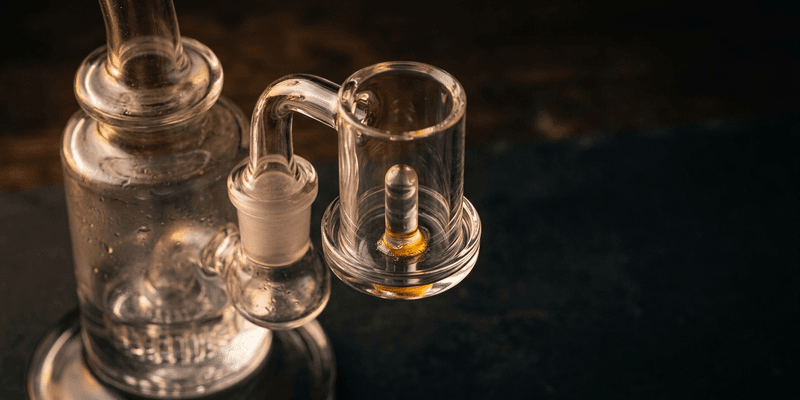
What a Terp Slurper Is and Why It Works
A terp slurper is a quartz banger with a multi-chamber design that creates a low-pressure vaporization environment. Instead of a single bucket where your concentrate sits in a pool, the slurper pulls concentrate through vertical slits in a bottom dish, up through a column, and past a capping marble at the top. The airflow path forces the concentrate to cycle through heated surfaces multiple times, which means more complete vaporization at lower effective temperatures. For live rosin and hash rosin, that translates to better flavor and less waste, the multi-chamber design preserves the terpene profile that makes solventless concentrates worth the price.
Anatomy of a Terp Slurper
A terp slurper has four main parts, and understanding each one explains how the whole system works together:
- Bottom dish: The lowest chamber where concentrate is loaded. It has vertical slits cut into the walls that allow air to flow upward when you inhale. The dish holds the bulk of the heat and is where vaporization begins.
- Vertical slits: Narrow openings in the dish walls that create the vacuum effect. When you draw air through the rig, airflow is restricted through these slits, lowering the pressure inside the dish. Lower pressure means the concentrate vaporizes at a slightly lower effective temperature, the same principle that makes water boil faster at high altitude.
- Column (tube): The vertical tube connecting the bottom dish to the joint of your rig. Vapor and any unvaporized concentrate travel up through this column. Some designs have a wider column, some narrower, narrower columns tend to create more airflow restriction and a stronger vacuum effect.
- Top opening: Where the column meets open air at the top. This is where a marble (valve marble) sits to cap the system and complete the sealed airflow path. Without the marble, air enters freely from the top, and you lose the pressure differential that makes the design work.
What Accessories You Need
A terp slurper without accessories is just an overcomplicated banger. The marble and either a pillar or terp pearls are what make the design function as intended.
Valve marble (top cap): A marble that sits on top of the column opening. It seals the system so that all airflow is forced through the bottom slits. This is not optional, without the marble, the slurper doesn't create the vacuum effect that defines its function.
Pillar (pill): A solid cylinder that sits inside the bottom dish. As concentrate vaporizes and cycles through the chamber, the pillar provides additional heated surface area and helps distribute heat more evenly across the dish. Pillars are the most common accessory for the bottom chamber.
Terp pearls: Small spheres that spin inside the bottom dish as airflow moves through the slits. The spinning action spreads concentrate across more heated surface area, promoting even vaporization. Some users prefer pearls over a pillar; others use both. The effect is similar, more surface contact, more complete vaporization.
What NOT to use: Soda lime glass marbles, the kind you find at dollar stores or in toy sets, will shatter or explode under torch heat. Soda lime glass is not rated for thermal shock. Your valve marble, pillar, and pearls must be borosilicate glass, ruby, silicon carbide (SiC), or quartz. This is a safety issue, not a preference. A soda lime marble exploding on a hot nail sends glass fragments in every direction.
For the slurper itself, American-made quartz from brands like Tiki Quartz, Evan Shore, Bear Quartz, and Terporium holds heat more consistently and has tighter tolerances on the slits than most imports. The price difference is real ($80–150 vs. $15–30), but so is the performance gap, cheap slurpers often have uneven slits that disrupt airflow or thin walls that lose heat too quickly.
How to Load and Use a Terp Slurper
The loading technique for a slurper is different from a standard banger. Here's the sequence:
- Place your accessories: Drop the pillar or terp pearls into the bottom dish. Set the valve marble nearby, you'll place it on top right before you inhale.
- Heat the bottom dish: Use a torch on the sides of the bottom chamber, not the bottom directly. Heating from the sides distributes heat more evenly across the dish and slits. Heating the bottom directly creates a hot spot that can scorch concentrate on contact.
- Let it cool to target temperature: If you're using an IR thermometer, aim for 500–560°F at the dish surface. If you're timing it, the cool-down window depends on your quartz thickness, thicker walls retain heat longer. Start with a longer cool-down and work shorter until you find the right window. See best temperature to dab rosin for more on dialing in temperature.
- Load from the top: Drop your concentrate through the top opening of the column so it falls into the bottom dish. Some users use a dab tool to place concentrate directly into the dish before capping, but dropping through the top keeps your tool away from the heated surfaces.
- Cap with the marble: Place the valve marble on top of the column immediately after loading. This seals the system and activates the vacuum effect.
- Inhale steadily: Draw at a consistent, moderate pace. You should see the concentrate bubbling and cycling through the slits in the bottom dish. If you're using terp pearls, they should be spinning. A slow, steady draw works better than a hard pull, too much airflow can cool the dish too quickly.
Temperature Guidance
Most slurper users land between 500–560°F measured at the bottom dish. The low-pressure environment inside the slurper means concentrate vaporizes at a lower effective temperature than it would in an open banger, so you don't need to run as hot as you might expect.
For full melt and six-star hash, drop to the lower end of that range, 500–520°F. These products melt cleanly and don't need extra heat. For flower rosin, which contains more plant lipids, you may need to push closer to 550–560°F for complete vaporization.
Terpene preservation is the whole point of running a slurper over a standard banger. The multi-chamber design gives you more vaporization at lower temperatures, which means more of the volatile monoterpenes (myrcene, limonene, pinene) survive the process intact. If you're running a slurper at 600°F+, you're defeating the purpose of the design, a standard banger would perform the same at that temperature with less cleanup.
Cleaning and Maintenance
Terp slurpers have more surface area and more crevices than a standard banger, which means cleaning after each use isn't optional, it's the price of admission. Residue that builds up in the slits will restrict airflow and ruin the vacuum effect that makes the design work.
- After every dab: While the quartz is still warm (not hot), use a cotton swab to wipe out the bottom dish, the column, and around the slits. Get the bulk of the residue while it's still liquid.
- ISO soak: If a swab doesn't get it all, dip the swab in isopropyl alcohol (91% or higher) and go over the surfaces again. For deeper cleaning, remove the slurper from your rig and soak the entire piece in ISO for 15–30 minutes.
- Slits and column: These are the hardest areas to keep clean. Pipe cleaners or thin cotton swabs can reach inside the column. If the slits are clogged with carbon buildup, a longer ISO soak (several hours or overnight) usually dissolves it.
- Accessories: Wipe down the marble, pillar, and pearls after each session. These collect residue too, and a dirty marble won't seal the top opening as effectively.
- Avoid torching off residue: Heating a dirty slurper until the residue burns off (chazzing) permanently damages the quartz surface. The cloudy, devitrified surface that results holds heat unevenly and degrades flavor over time.
Consistent cleaning is the difference between a slurper that performs well for years and one that's chazzed beyond use in a month. Judge your rosin quality by what's left in the dish, clean rosin at the right temperature should leave minimal residue.
Terp Slurper FAQ
Do I really need a marble, pillar, and pearls?
You need the valve marble, without it, the slurper doesn't create the pressure differential that defines how it works. The pillar or pearls are strongly recommended but technically optional. Without them, you lose the extra surface area and heat distribution they provide, and vaporization will be less complete. Most users run a marble plus either a pillar or pearls, not necessarily all three.
Can I use a terp slurper for cold starts?
You can, but the slurper design isn't optimized for it. Cold starts work best in a standard banger where you can see the concentrate and control heat application precisely. The slurper's multi-chamber design makes it harder to see when vaporization begins, and the slits and column add thermal mass that complicates the cold start timing. Most slurper users heat first, then load.
Why is my terp slurper not hitting well?
Three common causes: the marble isn't sealing the top properly (check for a flat or chipped marble), the slits are clogged with residue (clean them), or the temperature is off. If you're getting harsh hits, you're too hot. If there's a pool of unvaporized concentrate left in the dish, you're too cool or your draw was too fast.
Are cheap import slurpers worth buying?
They work, but with trade-offs. Import slurpers ($15–30) often have uneven slit widths that create inconsistent airflow, thinner walls that lose heat faster, and rougher interior surfaces that are harder to keep clean. American quartz from Tiki, Evan Shore, or Bear Quartz ($80–150) has tighter manufacturing tolerances and holds heat more evenly. If you're already spending $60–90/g on quality live rosin, a well-made slurper protects that investment.
How does a terp slurper compare to a regular banger?
A slurper vaporizes concentrate more completely at lower temperatures because of the multi-chamber airflow design. The trade-off is more complexity, more accessories, and significantly more cleaning. A standard banger with a good carb cap is simpler to use and maintain. The slurper is the better choice if you prioritize flavor and efficiency and don't mind the cleanup. For quick daily dabs, many users keep a standard banger as their everyday piece and bring out the slurper for premium hash rosin sessions.
What size terp slurper do I need?
Match the joint size of your rig, 14mm and 10mm are the most common. The bottom dish diameter varies by manufacturer, but standard-sized dishes work for typical dab sizes (0.05–0.2g). If you routinely take larger dabs, a larger dish retains more heat through the session. Check the joint angle too, most rigs use a 90-degree male joint, but some have 45-degree angles.