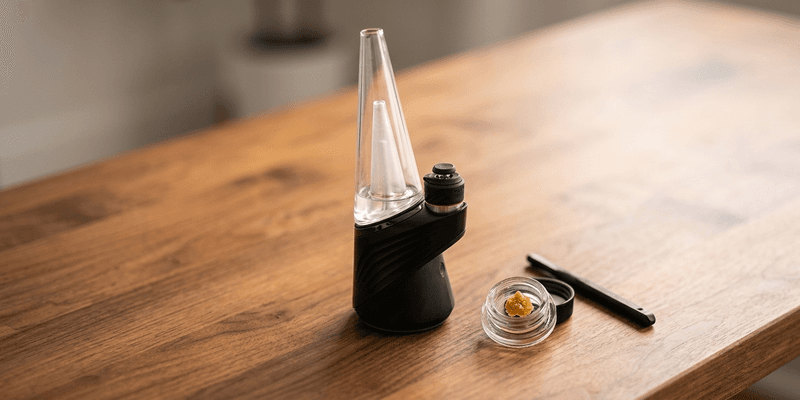
Best Settings at a Glance
The best Puffco Peak Pro settings for rosin depend on your chamber. If you are using the stock 3D chamber, start at 475°F. This number works for about 80% of users. Go lower (450 to 475°F) to preserve flavor and terpenes. Go higher (500 to 530°F) for thicker clouds or larger dabs. Different chambers need different ranges:
- Stock 3D chamber: 475 to 510°F
- 3DXL chamber: 470 to 505°F
- Aftermarket SiC insert: 480 to 520°F
- Aftermarket AlN insert: 460 to 500°F
If you've never used a Peak Pro before, load a rice-grain-sized dab and set the 3D chamber to 475°F. Cap it and take a slow draw. If the hit is too thin, go up 5 degrees. If it's harsh, go down 10. This is the easiest way to find your sweet spot.
Settings by Chamber Type
The chamber material changes how heat reaches your rosin. The app shows the temperature of the heating element, but the surface where the rosin sits is different. Ceramic, silicon carbide, and aluminum nitride all have different heat gaps. This is why 490°F on a stock chamber feels different from 490°F on an AlN insert.
Stock 3D Chamber (Ceramic)
The 3D chamber heats the walls and bottom at the same time. This is better than the old flat atomizers. Most people land between 475 and 510°F. Ceramic holds heat well but doesn't spread it as evenly as other materials. Using a terp pearl helps with this. Start at 475°F for live rosin and see how it feels.
3DXL Chamber
The 3DXL is just a bigger 3D chamber. The larger bowl lets the rosin spread out, which makes it vaporize better. You can usually run this about 5 degrees lower than a standard 3D chamber. Most users stay between 470 and 505°F. The XL is best for dabs larger than 0.15g where the standard chamber might overflow.
Aftermarket SiC (Silicon Carbide) Insert
SiC heats up faster and more evenly than ceramic. It also holds that heat better while you inhale. It runs a bit hotter than the ceramic chamber, so you might need to bump your app settings up by 5 or 10 degrees. The range is 480 to 520°F for most rosins. SiC is also much easier to clean. A warm swab usually clears it right up.
Aftermarket AlN (Aluminum Nitride) Insert
AlN is the best material for heat transfer. It heats evenly and delivers the best flavor of any Peak Pro accessory. Because it is so efficient, you can run it 15 to 20 degrees lower than ceramic and still get great vapor. The range is 460 to 500°F. These inserts are expensive, but they are worth it if you care about flavor. AlN is the favorite among people who only smoke high-end rosin.
Settings by Rosin Type
How your rosin was made changes its melting point. Here is how to adjust your Peak Pro for different products:
- Live rosin: 470 to 500°F. The fresh-frozen terpenes are very delicate. Use the low end for the best taste.
- Hash rosin (cured): 480 to 510°F. It has fewer light terpenes, so it can take a little more heat.
- Full melt or six-star: 440 to 480°F. This melts at the lowest temperatures. If you use 500°F on full melt, you are wasting the best parts of it.
- Flower rosin: 490 to 530°F. It has more plant lipids and waxes, so it needs more heat to fully vaporize. Expect more residue in the bowl.
- Cold cure or badder: 475 to 505°F. The texture makes it easy to load and melt. Start at 480°F.
- Fresh press: 465 to 495°F. Handle this cold and load it fast. It has the most volatile terpenes, so keep the heat low to preserve them.
Check how to read rosin labels if you aren't sure what you have.
Custom Profiles in the Puffco App
The Puffco app is where you really dial things in. The four default settings on the base are fixed. You need the app to change them. Once you connect, you can set the exact temperature to the degree. You can also change the session length and the light colors.
A good setup is 465°F for full melt, 480°F for live rosin, 500°F for daily dabs, and 520°F for flower rosin. This covers everything you need without opening the app every time. One trick most people miss is stealth mode. Click the button four times while it's on to turn off the lights. It's great when you don't want a light show, but you lose the visual feedback for your temperature.
Keep your firmware updated. Puffco sometimes changes how the heater works. If your dabs taste different after an update, you might need to move your settings by 5 or 10 degrees. Read about terpene preservation to understand why these small changes matter.
Accessories for Better Sessions
The temperature setting is only half the battle. Airflow and heat distribution matter just as much.
Terp pearls are small beads that spin inside the chamber. They spread the rosin around so it vaporizes better. They make a big difference in the Peak Pro. You get more consistent vapor and less pooling. Use 3mm pearls for the 3D chamber and 4mm for the 3DXL. When you use a pearl, you can usually drop your heat by 10 degrees and still get the same vapor.
The stock cap is fine, but a ball cap or joystick cap gives you more control. Tighter seals create lower pressure in the chamber, which helps the rosin vaporize at lower temperatures. A better seal means more vapor at the same setting.
Common Mistakes
Starting too hot is the biggest mistake. If you cough or the flavor is gone, the heat is too high. Drop to 460°F and work up. You can always reheat a dab, but you can't fix burnt flavor. Another mistake is overloading the bowl. A rice-grain-sized dab is the limit for the 3D chamber. If you put too much in, it will overflow and make a mess.
Always swab the chamber with a dry cotton tip while it is still warm. If you leave it, carbon will build up and ruin the flavor. Use Dark Crystal cleaner for deep cleans. It's safe and effective for ceramic. Never ignore firmware updates, as they often improve how the heater behaves. Finally, don't just copy someone else's settings if they have a different insert material. Every material heats differently.
Puffco Peak Pro Rosin Settings FAQ
What is the best temperature for live rosin?
470 to 500°F on the 3D chamber. Start at 475°F. Live rosin has delicate terpenes that burn away above 500°F. Stay low for the best taste.
Should I use the 3D or 3DXL chamber?
The 3D is great for standard dabs. The 3DXL is better for large loads or sharing. If you smoke high-end hash rosin, the 3D is usually enough.
Is an AlN or SiC insert worth it?
Yes. They spread heat better than ceramic, so the flavor is more consistent. AlN is the favorite for pure flavor. SiC is easier to clean. They are a great upgrade if you spend money on high-end rosin.
Do terp pearls help?
They do. They spread the rosin across the hot surface, which helps it vaporize. You can often lower your temperature by 5 or 10 degrees when using a pearl. A 3mm ruby or SiC pearl is best.
Why does my rosin taste burnt?
The heat is too high. Drop 20 degrees and try again. If it still tastes bad at 460°F, your chamber might have carbon buildup. Soak it in isopropyl alcohol or Dark Crystal cleaner. Also check that your rosin was stored correctly. Old rosin tastes worse.