The Short Answer
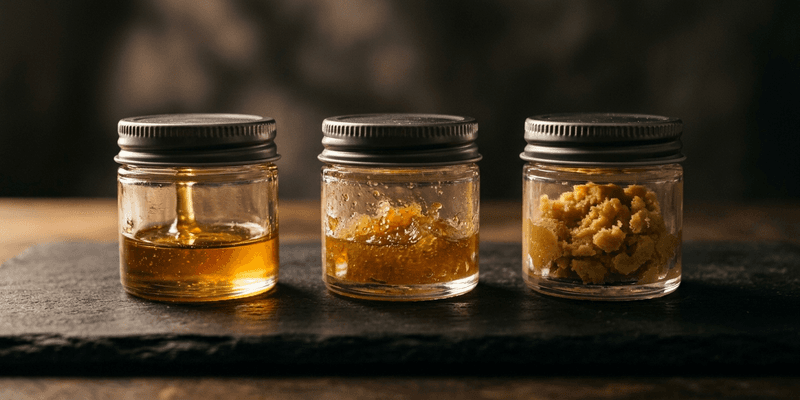
Curing rosin means letting freshly pressed hash rosin sit in a sealed glass jar at a controlled temperature so its texture and terpene expression change over time. The most common method is cold cure: seal the rosin in a jar at room temperature (65-75°F) and wait anywhere from three days to several weeks. The rosin gradually shifts from a sappy, pull-and-snap consistency into a creamy badder or budder. The other main approach is warm cure, which uses mild heat (90-110°F) to speed up the process. Both methods are passive — you're not adding anything, just giving the rosin's cannabinoids and terpenes time to nucleate and reorganize.
Cold Cure: Step by Step
Cold cure is the dominant technique among home pressers and commercial producers alike. It produces a smooth, workable badder texture while preserving the volatile terpenes that define terpene preservation in solventless concentrates.
What you need: freshly pressed rosin, a small glass jar with an airtight lid (half-pint mason jars or small borosilicate concentrate jars work well), and a stable environment between 65-75°F.
- Collect your fresh press. Transfer the rosin from parchment into the glass jar. Work quickly — the less you handle it with warm fingers, the better. A cold dab tool helps.
- Seal the jar completely. The lid needs to be airtight. Terpenes are volatile organic compounds and they will off-gas through any gap. A loose lid means lost flavor.
- Store at room temperature. Find a spot that holds steady between 65-75°F. A closet or cabinet works. Avoid locations near windows, heaters, or appliances that cycle temperatures.
- Wait. Most rosin begins showing visible texture changes within 24-72 hours. The surface may look greasy or start to lighten in color. Some batches look like wet sourdough starter midway through — that's normal nucleation.
- Check progress every few days. Open the jar briefly to assess consistency. You're looking for the rosin to firm up from a sappy pull-and-snap into a softer, more uniform badder. Once the entire mass has an even, creamy texture with no glassy or sappy pockets, the cure is complete.
Timeline varies by cultivar. Some strains with high monoterpene content (limonene, myrcene) cure faster — sometimes in three to five days. Others take two to three weeks. Terpene profile is the biggest variable, not technique. See what is cold cure rosin for more on the underlying process.
What Happens During the Cure
Curing is a passive physical process, not a chemical reaction. When rosin sits sealed at stable temperatures, the cannabinoid and terpene molecules slowly reorganize through nucleation. THCa crystals begin to form tiny structures within the terpene-rich matrix, and this crystallization pushes terpenes outward into the surrounding space. The result is a more homogeneous mixture where terpenes are more evenly distributed instead of trapped in pockets.
This is why cured rosin often smells and tastes stronger than fresh press of the same batch — the terpenes aren't being created during the cure, but they become more accessible. The texture change from sappy to creamy is a visible indicator that nucleation has occurred throughout the mass.
Different terpene profiles produce different cure outcomes. Strains heavy in caryophyllene and humulene tend to cure into stiffer, dryer textures. Strains heavy in limonene and linalool often produce softer, more sauce-like badders. This is why two rosin batches cured identically can end up looking and feeling completely different.
Room Temp vs Warm Cure vs Fridge Cure
Room temperature (65-75°F) is the standard. It's the slowest passive method but preserves the most volatile terpenes. Most of what the solventless community calls "cold cure" happens in this range. This is the default recommendation for home curers.
Warm cure (90-110°F) accelerates nucleation. Some producers use a heat mat or warm water bath to hold jars at a controlled warm temperature for 24-48 hours. The cure happens faster, but you trade off some of the lighter terpenes that begin to volatilize above 80°F. Warm cure produces a more uniform budder, sometimes with a slightly muted flavor compared to cold cure. It's a practical choice for commercial operations that need faster turnaround.
Fridge cure (35-45°F) slows everything down dramatically. Some producers use fridge temperatures to hold fresh press rosin in a stable state before beginning a room-temperature cure later. On its own, fridge temperatures are generally too cold for meaningful nucleation to occur — the rosin stays in its original state. This method is better understood as cold storage than as an active cure. If your rosin isn't changing texture after a week in the fridge, that's why.
The tradeoff across all three is the same: more heat means faster results with more terpene loss, less heat means slower results with better preservation. Most experienced pressers land on room temperature as the best balance. See cold cure vs fresh press for how the final products compare.
The Piatella Technique
Piatella is an advanced finishing step applied after the cure is already complete. The concept originated in the European hash scene and has gained traction among solventless producers looking for a specific dense, waxy presentation.
The process: take fully cured rosin badder, place it between two sheets of parchment paper, and press it flat — by hand, with a rolling pin, or with very light pressure on a rosin press at room temperature. The goal is to compress the cured badder into a thin, uniform slab. Some producers then reseal the flattened rosin in a jar for additional time (days to weeks) to let it stabilize.
Piatella isn't a different cure method — it's a post-cure manipulation. The pressing reorganizes the crystal structure of the already-nucleated rosin, producing a denser, more stable texture that some consumers prefer for its ease of handling. The result looks like a smooth, flat disc or patty rather than a fluffy badder.
This technique works best with rosin that has already completed a thorough cold cure. Attempting piatella on insufficiently cured rosin (still sappy or unevenly nucleated) typically produces inconsistent results.
Common Mistakes
- Using silicone containers. Silicone leaches terpenes from concentrates on contact. This isn't debatable — terpenes are solvents, and they interact with silicone at the molecular level. Glass jars only for curing. Silicone is fine for short-term handling but not for any process measured in days or weeks. See how to store live rosin for proper container guidance.
- Too much heat. Keeping jars above 80°F, even unintentionally (near a grow light, on top of a warm appliance), accelerates terpene off-gassing. The jar may smell amazing when you open it — because the terpenes left the rosin and filled the headspace instead of staying in the product.
- Opening the jar too often. Every time you break the seal, you release terpene-rich air and introduce fresh oxygen. Check once every two to three days, not twice a day. The cure doesn't need supervision — it needs patience.
- Overfilling the jar. Leave some headspace. If rosin is packed to the brim against the lid, it can't breathe within the sealed environment and the cure may proceed unevenly.
- Inconsistent temperatures. A room that swings between 60°F at night and 80°F during the day will produce uneven nucleation. The rosin may cure in patches — some parts budder up while others stay sappy. Find a spot with minimal temperature fluctuation.
- Expecting every strain to cure the same way. Some cultivars cure beautifully into smooth badder in four days. Others barely change after two weeks. Terpene composition determines the outcome more than anything you do. If a particular batch doesn't want to budder up, that's the plant, not your technique.
How to Know When the Cure Is Done
There's no universal timeline. The cure is done when the texture is consistent throughout and matches the consistency you're after. For most people targeting badder, that means:
- No remaining sappy, glassy, or translucent pockets — the mass should be opaque and uniform
- A creamy, scoopable texture that holds its shape on a dab tool
- The rosin no longer changes noticeably between checks (the texture has stabilized)
- A strong, clean terpene aroma when the jar is opened — not muted, not overwhelming
If you prefer a lighter cure — somewhere between fresh press and full badder — you can stop the process early by moving the jar to the freezer. Cold temperatures halt nucleation and lock the rosin at whatever stage it has reached. Some people intentionally do a partial cure to get a halfway texture that isn't quite as sappy as fresh press but not as stiff as fully cured badder.
Once your cure is complete, store the sealed jar in the fridge or freezer for long-term preservation. Cured rosin at room temperature will continue to slowly change over weeks and months — the nucleation doesn't stop, it just slows down. Cold storage keeps it where you want it. If you notice your cured rosin losing moisture or becoming crumbly over time, see why rosin dries out for causes and prevention.
Curing Rosin FAQ
How long does it take to cold cure rosin?
Most rosin shows visible changes within 24-72 hours and reaches a full badder consistency in 3-14 days at room temperature. Some strains take up to three weeks. The variable is the plant's terpene profile, not your process. Check every few days and stop when the texture is uniform.
Do I need to cure rosin or can I use it fresh?
Curing is a preference, not a requirement. Fresh press rosin is a finished product that many people prefer for its sappy consistency and bright, immediate terpene expression. Curing changes the texture and can make terpenes more pronounced, but it doesn't make the rosin "better" in any objective sense. Try both and see which you prefer.
Can I cure flower rosin the same way as hash rosin?
The same principles apply, but flower rosin contains more plant lipids and waxes than hash rosin, which affects the final texture. Flower rosin may not achieve the same smooth badder consistency — it often cures into a grainier, less uniform product. The process is the same: sealed glass jar, room temperature, patience.
Why did my rosin not budder up during the cure?
Most likely the terpene profile of that particular cultivar doesn't favor nucleation into badder. Some strains produce rosin that stays sappy or glassy regardless of cure time. Temperature too low (below 60°F) can also stall the process. If nothing has changed after two weeks at 65-75°F, that batch probably won't budder — and that's fine.
Is warm curing better than cold curing?
Warm curing is faster but sacrifices some volatile terpenes. Cold curing is slower but preserves more of the terpene profile that makes live rosin worth the premium. Neither is objectively better — warm cure is a practical choice for speed, cold cure is the choice for maximum terpene retention.
Can I cure rosin in silicone containers?
No. Terpenes are solvents that interact with silicone, pulling material out of the container and into your concentrate while simultaneously leaching terpenes out of the rosin. Use glass jars with airtight lids. This applies to any storage longer than a few hours — and curing is measured in days to weeks.
