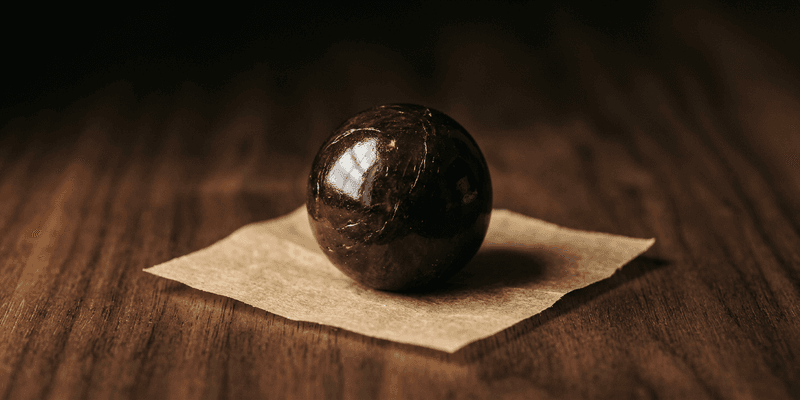
Temple Ball at a Glance
A temple ball is a sphere of pressed and aged hashish, formed by hand-rolling high-quality resin into a dense, smooth ball and curing it over weeks or months. The form originates from traditional hash-producing regions in Nepal, India, and Afghanistan, where artisans shaped collected resin into balls for storage and transport. In modern solventless cannabis, temple balls are typically made from bubble hash, ice water extracted trichome heads, rather than hand-rubbed charas. The result is a concentrated, terpene-rich hash that develops complexity as it ages, much like a wheel of cheese or a bottle of wine.
History and Origins
Temple balls trace back centuries to the hashish traditions of South and Central Asia. In Nepal, hand-rubbed cannabis resin (charas) was collected from living plants and rolled into dark, glossy spheres. The name "temple ball" likely refers to the hash offered at temples and spiritual sites throughout the region, though the exact etymology is debated. Similar traditions existed across northern India, Afghanistan, and parts of Pakistan, each with regional variations in collection method and curing practice.
These traditional temple balls were made from charas, resin rubbed directly from living cannabis plants by hand. The quality varied enormously. The best were smooth, dark, and pliable. The worst were cut with fillers and plant material. Either way, the spherical form served a practical purpose: it minimized surface area relative to volume, slowing oxidation and preserving the hash during long storage and overland trade.
The modern revival of temple balls is closely associated with Frenchy Cannoli, a French-born hashishin who spent years traveling through traditional hash-producing regions before settling in California. Frenchy combined the old-world temple ball form with modern starting material, bubble hash made through ice water extraction rather than hand-rubbed charas. His technique produced temple balls of a purity that traditional methods rarely achieved, and he taught the process openly through workshops and online demonstrations until his passing in July 2021. His wife Kimberly has continued to preserve and share his legacy.
How Temple Balls Are Made
A modern temple ball starts with high-quality bubble hash, typically from the 73-micron bag (often called "73er" in the community) or a similar fine-micron collection. This is the same full melt or near-full-melt grade hash prized for its purity, mostly trichome heads with minimal plant contamination. The better the starting hash, the better the temple ball. You cannot hide poor input material inside a sphere.
The process Frenchy Cannoli popularized works roughly like this:
- Dry the bubble hash thoroughly. The hash must be fully dried, typically freeze-dried or microplaned and air-dried, before pressing begins. Residual moisture leads to mold during the aging process.
- Press with gentle heat. The dried hash is placed in parchment and pressed using a wine bottle or glass jar filled with hot water. The heat softens the trichome heads enough to fuse together without destroying terpenes. The goal is to work the material into a uniform, pliable mass.
- Hand-roll into a sphere. Once the hash is warm and workable, it's rolled by hand into a ball. This is labor-intensive, community members report 10-12 hours of work time for a single batch, repeatedly heating, pressing, and rolling to achieve a smooth, glossy surface with no air pockets.
- Wrap and age. The finished ball is wrapped tightly (often in cellophane or parchment) and stored in a cool, dark environment to cure. Aging periods range from a few weeks to several months. During this time, the terpene profile develops and the texture becomes more uniform throughout.
The labor and patience involved is part of what makes temple balls distinctive. This is not a quick extraction product. It's a craft form that requires hands-on skill and time. For a detailed walkthrough of the ice water extraction step, see how to make bubble hash.
What Makes a Good Temple Ball
Quality indicators for temple balls are straightforward once you know what to look for:
- Purity of starting material. A good temple ball is made from high-grade bubble hash, ideally six-star or near-six-star heads. The finished ball should be nearly free of visible plant material. As one community member put it: "just heads and maybe sticks", meaning trichome stalks, not leaf matter.
- Surface finish. A properly pressed temple ball has a smooth, glossy exterior. The surface should look almost polished, without cracks, dry patches, or visible particulate. Well-made ones are often compared to Maltesers candy or chocolate truffles in appearance.
- Texture at body temperature. Premium temple balls made from pure trichome heads will begin to soften noticeably at body temperature. If you hold one in your palm, it should warm and become slightly pliable. This is a direct indicator of trichome head content, plant material and contaminants don't melt at body temperature.
- Aroma. A well-aged temple ball should have a rich, complex terpene profile. The aging process develops depth that freshly dried hash doesn't have. If it smells flat or like hay, the starting material or the curing process had issues. See what terpene preservation means for more on why this matters.
- Uniformity. When you cut or break open a temple ball, the interior should be consistent in color and texture, no pockets of dry, unworked hash or moisture. A uniform interior means the pressing was thorough and the cure was even.
Temple Balls vs Other Hash Forms
Temple balls occupy a specific niche within the broader world of hash and solventless concentrates:
- Temple ball vs loose bubble hash: Same starting material, different form. Loose bubble hash is the raw extracted product; a temple ball is that product pressed, shaped, and aged. The aging process changes the terpene profile and texture in ways that loose hash sitting in a jar does not replicate. Storage is also better, the sphere's low surface-area-to-volume ratio slows oxidation compared to loose, granular hash.
- Temple ball vs rosin: Hash rosin applies heat and pressure to extract a dabbable concentrate from bubble hash. Temple balls apply gentle heat to fuse the hash into a solid mass without separating the resin from the trichome structure. They're different end products from similar starting material, rosin is designed for dabbing, while a temple ball is a traditional hash form meant to be aged and consumed differently.
- Temple ball vs dry sift: Dry sift is mechanically separated resin collected through screens without water. It can be pressed into temple balls, though bubble hash is the more common modern starting material because ice water extraction typically achieves higher purity.
- Temple ball vs traditional charas: Traditional charas is hand-rubbed resin collected directly from living plants. It contains more plant oils and material than ice water extracted hash. Modern temple balls made from bubble hash are significantly purer than their charas-based ancestors, though some purists argue the traditional method produces a different, valued character.
How Temple Balls Are Used
Temple balls are versatile in how they can be consumed, though the method matters for getting the most from the product. Small pieces can be broken or sliced from the ball and added to a bowl, rolled into a joint, or vaporized. Because the material is dense and compressed, it burns or vaporizes more slowly than loose hash, which some users prefer for a longer, more even session.
For vaporizing, the same temperature principles that apply to other solventless concentrates apply here, lower temperatures preserve more of the terpene complexity that the aging process developed. The quality of the starting material determines whether a temple ball can achieve full melt behavior. A temple ball made from six-star heads will melt cleanly; one made from lower-grade hash will leave residue. See how to read hash grades for more on what grade means in practice.
Temple Ball FAQ
What is a temple ball made of?
A modern temple ball is made from bubble hash, trichome heads separated from cannabis using ice water and mesh screens. The hash is pressed with gentle heat, hand-rolled into a sphere, and aged. Traditional temple balls were made from charas (hand-rubbed resin), but most contemporary versions use ice water extracted material for higher purity.
Why are they called temple balls?
The name refers to the hashish traditions of Nepal and surrounding regions, where hand-rolled resin balls were historically associated with temples and spiritual practices. The exact origin of the term is debated, but the spherical form has been documented in South Asian hash culture for centuries.
How long do you age a temple ball?
Aging periods vary. Some makers cure temple balls for 2-4 weeks before considering them ready. Others age them for 3-6 months or longer, reporting that the terpene profile continues to develop and deepen over time. There is no single correct duration, it depends on the starting material, storage conditions, and personal preference.
Who popularized modern temple balls?
Frenchy Cannoli is widely credited with reviving the temple ball form for modern cannabis. He adapted traditional techniques from Nepal and Morocco to work with bubble hash made from high-quality, domestically grown cannabis. His open-source teaching approach, workshops, videos, and community engagement, made the technique accessible to home hash makers worldwide.
Can you dab a temple ball?
Yes, if the starting material is high enough quality. A temple ball made from six-star or full-melt bubble hash will melt cleanly on a nail or in an e-rig. Temple balls made from lower-grade hash will leave residue and are better suited to bowls, joints, or dry herb vaporizers.
How big should a temple ball be?
There is no standard size. Home producers commonly make temple balls ranging from a few grams to 20 grams or more. Larger balls have a lower surface-area-to-volume ratio, which theoretically improves long-term storage by reducing oxidation. Size is mostly a function of how much starting material you have and personal preference.